Disclaimer: SneakerRank is reader-supported. When you buy through links on our site, we may earn an affiliate commission at no extra cost to you. Prices are checked regularly across major Canadian storefronts and may not reflect the most recent change.
Navigating the Canadian sneaker landscape often means confronting a frustrating reality: the most desired Jordan retros are virtually impossible to find at retail. Major storefronts like Nike CA, Foot Locker CA, and JD Sports CA sell out of marquee releases in minutes, leaving secondary market platforms as the only consistent procurement route. For everyday buyers in Canada, entering the world of digital resale requires looking past the basic listed price and understanding how verification fees, shipping logistics, and cross-border customs impact the true final cost.
Quick Summary: Resale buying is generally worth it if you are searching for an iconic, long-sold-out sneaker that will not return to retail for years. However, because final checkout bills include multi-layered transaction fees and international transport costs, buyers must weigh the absolute premium against their personal budget before purchasing.
StockX vs GOAT: What's the Difference?
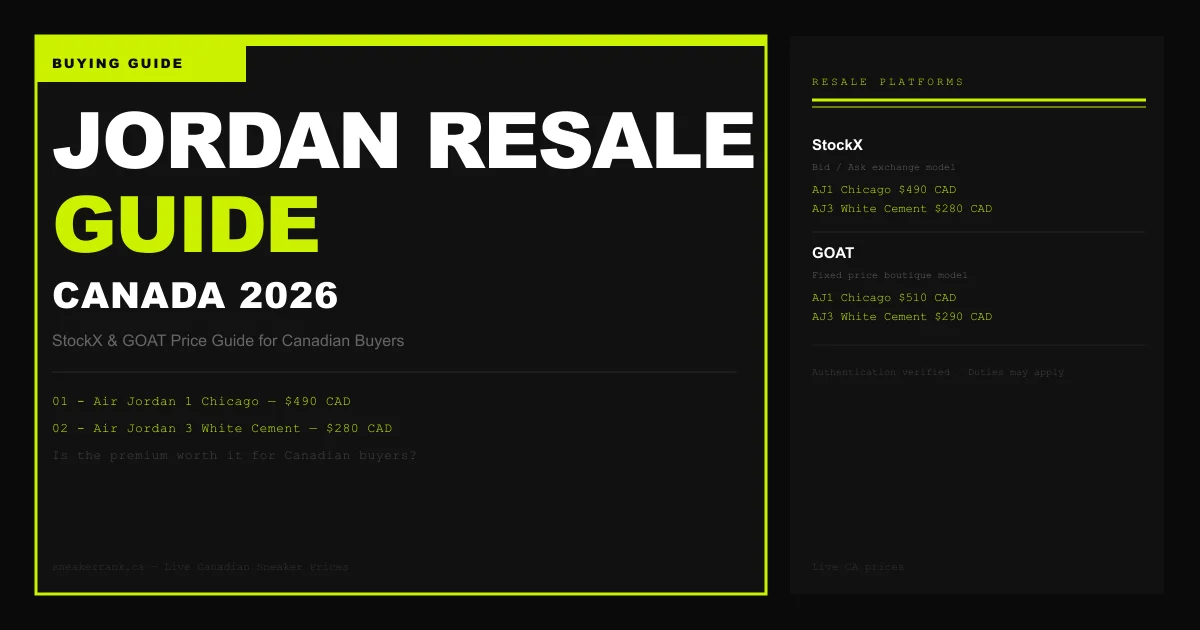
While both StockX and GOAT function primarily as secure authentication marketplaces rather than standard e-commerce shops, their underlying transactional mechanisms operate quite differently. StockX is modeled explicitly after a traditional commodities stock exchange, relying heavily on a live, transparent bidding and asking framework. Buyers can choose to purchase a sneaker instantly at the lowest active global asking price, or place a formal bid to negotiate a lower cost with independent sellers worldwide.
GOAT leans closer to a premium digital boutique marketplace, allowing secondary merchants and private collectors to list unworn inventory at fixed price points. In terms of fulfillment infrastructure, both platforms mandate that the independent seller routes the physical product directly to a centralized verification hub first. However, GOAT features a specialized "Instant Ship" tier for pre-verified pairs sitting in their warehouses, while StockX operates localized distribution nodes, including physical infrastructure inside Canada, to match domestic buyers and sellers directly.
What It Actually Costs to Buy Resale in Canada
The most common mistake Canadian sneaker buyers make is assuming that the base sticker price matches the final checkout cost. Secondary marketplaces add a multi-layered stack of expenses that significantly shifts the final bill. Every transaction includes a mandatory platform processing fee to cover the rigorous physical authentication process, supplemented by flat-rate international shipping costs to transport the product safely across Canadian borders. Furthermore, standard regional sales taxes apply during checkout, and currency conversion fluctuations can introduce variable premiums if a platform processes transactions through international banking institutions rather than localized currency streams.
To understand how this fee stack scales, consider the two primary tracked Jordans in Canada as reference points:
- Air Jordan 3 Retro White Cement: With a secondary market starting price of $280 CAD, this sneaker serves as a lower-entry baseline. During checkout, the required shipping fees and platform processing charges add a noticeable layer to the subtotal, though the lower base cost limits the total tax footprint.
- Air Jordan 1 Retro High OG Chicago: At a premium baseline starting price of $490 CAD, the financial layout scales significantly. Because import taxes and standard provincial sales variables are calculated directly as percentages of the base asset value, a higher starting ask results in a much larger absolute fee expansion by the time you reach the final checkout screen.
Additionally, cross-border customs fees present an important operational difference between the networks. StockX utilizes an all-in hybrid pricing architecture for Canadian users, meaning any potential international duties are calculated and built straight into the upfront asking price, so duties are not collected separately at your door. Sales taxes are still calculated and applied at checkout as a separate line item. GOAT's handling of Canadian duties is less standardized, so buyers should generally expect the possibility of an import assessment collected by the delivery courier and budget accordingly.
Is It Worth It? A Practical Take
Paying an open-market premium for a sneaker makes objective sense under very specific conditions. If your heart is completely set on a historical piece of design heritage, such as the classic high-top Chicago colorway, and you plan to wear it regularly as a core pillar of your style rotation, the resale price is a justifiable expense. Because the brand holds authentic production runs of these historic models for multiple years at a time, secondary marketplaces serve as a valuable, secure utility that unlocks access to global supply channels that simply do not exist at your local mall.
Conversely, entering the resale space is rarely worth the financial friction if you are a flexible, casual buyer who simply wants a clean daily sneaker. If you are indifferent to exact style codes or specific historical color blocking, paying processing premiums and cross-border shipping charges is highly inefficient. In those scenarios, you are far better off browsing active lifestyle inventories at traditional Canadian retailers, where you can secure high-quality baseline models without facing secondary market markups.
FAQ
Compare & Explore
To see how these two iconic silhouettes stack up in terms of physical dimensions, underfoot cushioning, and material composition, visit our structured Air Jordan 1 vs Air Jordan 3 Comparison Hub. You can also view active marketplace tracking, historical colorways, and active inventory paths by exploring the complete Jordan Brand Directory or diving straight into our individual Air Jordan 1 High Chicago Tracker.